An AI agent is formed by two essential parts: a reasoning loop and a set of tools.
The reasoning loop is the agent’s thinking process. It is the continuous cycle of observing what is happening, interpreting the available information, planning what to do next, and acting on that plan.
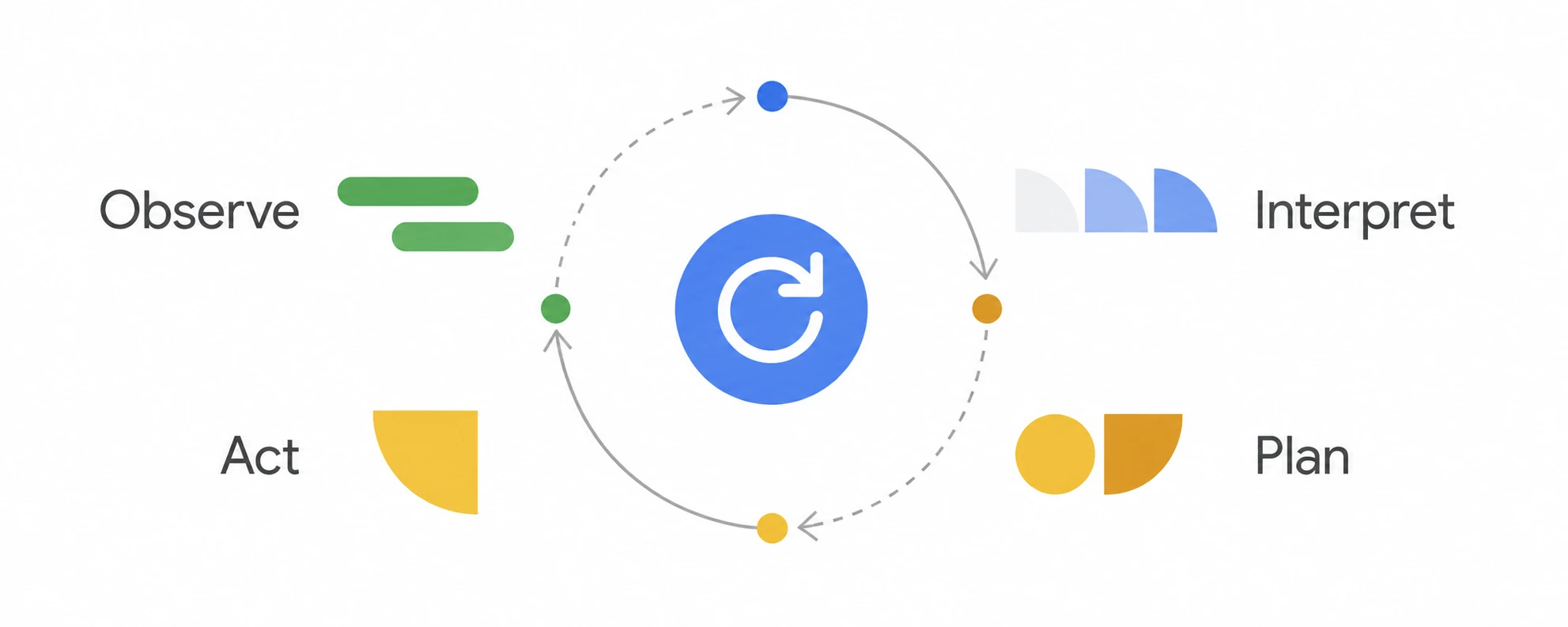
Tools are the functions that let the agent interact with its environment. They can be simple, like reading files or searching the web, or more specialized, like accessing databases, calling APIs, controlling browsers, or operating physical robots.
The combination of reasoning and tool use is what makes agents more interesting than plain language model prompts.
Beyond text generation
Large language models are very good at generating and transforming text. Agents build on that ability, but they also move beyond it. Instead of only answering a question, an agent can gather information, inspect its environment, use tools, update its plan, and keep working toward an outcome.
That shift changes the shape of what AI systems can do. A prompt usually produces a response. An agent can work through a problem.
When solving problems, agents analyze information, transform data, call external systems, and make decisions with less direct human intervention. They are not just producing text; they are coordinating work across systems.
What makes an agent
Useful agentic systems tend to have five important capabilities:
- Autonomous operation: working independently toward an objective, not only responding to isolated queries.
- Reasoning and planning: using advanced models to decide what to do next, not just what to say next.
- Memory and context use: using memory or accumulated context to improve behavior during future work.
- Environmental awareness: observing surroundings through inputs like user requests, API responses, database state, logs, files, and error messages.
- Tool use: interacting with the outside world through available tools. Model Context Protocol (MCP) is becoming a common pattern for exposing those tools.
These capabilities do not need to be equally advanced in every system. A coding agent, a customer support agent, and an operations agent may all have different levels of autonomy, memory, and tool access. But the same basic pattern is present: reason about the situation, choose an action, use a tool, observe the result, and continue.
Why it matters
The practical value of agents is that they turn AI from a passive interface into an active participant in a workflow.
They can take you:
- from reactive prompts to autonomous goals.
- from text generation to system integration.
- from fixed scripts to reasoning and planning.
- from isolated answers to end-to-end resolution in areas like marketing, support, engineering, and operations.
That does not mean every problem needs an agent. Many tasks are better served by a simple prompt, a deterministic script, or a traditional application. But when a task requires multiple steps, changing context, external systems, and judgment along the way, the agent model becomes much more useful.
At its core, an AI agent is an AI system that can reason, act, observe, and keep going.
Learn more
For a structured introduction, Google has a learning path on agents and its agent ecosystem.